


Blog
Age Hardening (Precipitation Hardening) Explained: Understanding the Heat Treatment Process for Metals

Age hardening, which people also refer to pas recipitation hardening, stands as one of the most important heat treatment techniques used in metallurgy. This method not only enhances the strength and endurance of metals but also establishes itself as an essential process for producing everything from aerospace parts to common tools. The mechanism produces reliable results through processes that remain unknown to us. The article will explain the scientific principles of age hardening, describe the complete industrial application process, and demonstrate its vital role in creating advanced performance alloys. The guide delivers essential knowledge about this exceptional process to both metal treatment experts and those who want to learn about its internal operations.
Definition and Overview of Age Hardening
Age hardening, also known as precipitation hardening, serves as a heat treatment method that enables metal alloys to achieve enhanced strength through its application. The material undergoes microstructure alterations through a series of heating and cooling processes, which operators control with exact specifications. The process produces small particles that function as precipitates to obstruct dislocation movement inside the metal. The material achieves increased hardness and strength because of this process ,although its ductility remains largely intact. Age hardening serves as a common practice in industrial sectors that demand materials with exceptional performance capabilities, including aerospace and automotive production.
What is Age Hardening?
People use the term precipitation hardening to describe age hardening because it serves as a heat treatment process that enhances the strength and hardness of certain alloys through the formation of tiny precipitates, which obstruct dislocation movement within their metal structure.
Scientific Principles of the Hardening Process
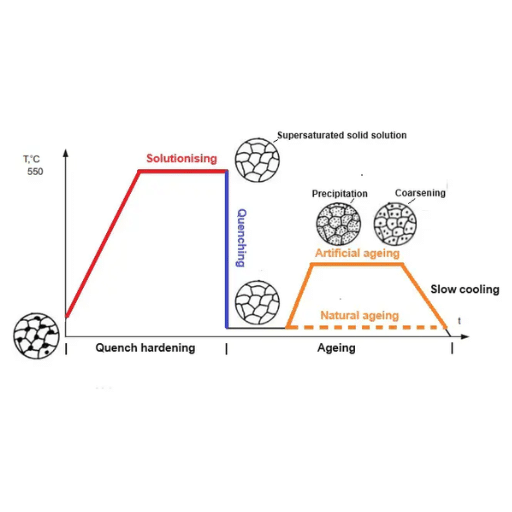
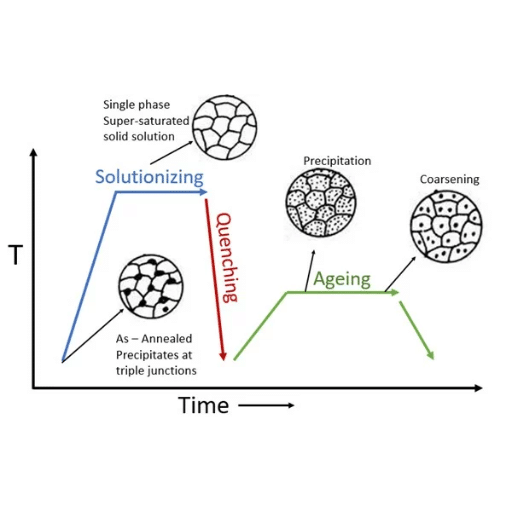
The age-hardening process requires specific microstructural changes through heat treatment to achieve its target outcomes. The process consists of three fundamental phases:
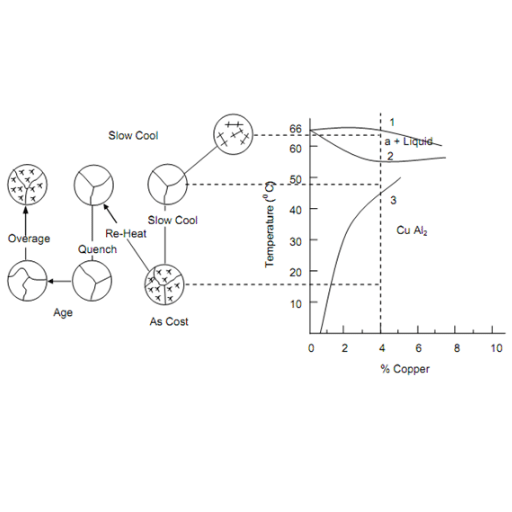
Solution Treatment: The alloy reaches its maximum heating point, which falls between 850°F and 1,200°F according to the material specifications. The metal matrix dissolves all alloying elements, which include aluminum, copper, and titanium, at this specific temperature.
Quenching: The alloy undergoes solution treatment followed by immediate temperature reduction via immersion in water or oil. The cooling procedure, which occurs at high speed, maintains dissolved alloying elements inside an oversaturated solid state until their precipitation process stops.
Aging: The process’s final stage requires the alloy to be reheated at a specific temperature, which remains below the solution treatment temperature for an extended time. The supersaturated solution undergoes decomposition in this stage, resulting in tiny precipitate particles that emerge throughout the metal matrix. The precipitates create obstacles that block dislocation movement, resulting in significant increases in the alloy’s hardness and strength.
Key Data and Metrics on Age Hardening
The research demonstrates that precipitate size and uniformity determine the material’s mechanical properties after processing. Aluminum alloys reach their optimal strengthening when their precipitate size exists within the 10-nanometer to 50-nanometer (nm) range.
Research demonstrates that age hardening increases yield strength by 40 to 60 percent in specific aluminum-copper alloys, which include 2024 Aluminum. The aging temperature of an alloy generally falls between 250°F and 450°,F which corresponds to 120°C and 230°C. The precipitate-strengthening effect disappears when the temperature exceeds this point because over-aging causes precipitate coarsening.
The aging process requires specific time durations for its successful completion. The experimental results, which tested titanium alloys, showed that any aging duration that exceeded 12 hours would lead to decreased benefits because of over-aging.
The heat treatment method requires precise contro,l which results from standards and parameters. Age hardening shows versatility, which allows its use in multiple high-strength alloy applications that require industries to achieve excellent material mechanical performance.
Key Terms in Precipitation Hardening
Solution Treatment
The first step in precipitation hardening begins with alloy heating until the material reaches its required high temperature that keeps the solid solution in a single-phase state. Aluminum alloys undergo solution treatment between 900°F and 1000°F, which corresponds to their specific alloy development.
The Quenching Process
The alloy undergoes rapid cooling after solution treatment through a process called quenching, which involves using water or oil as the cooling medium. Quenching produces a supersaturated solutio,n which stops dissolved elements from precipitating while it readies the material for its next phase. The cooling rate in this step determines both the microstructure and material properties that will be achieved.
Aging
Aging requires controlled reheating of the alloy to mid-range temperatures which for aluminum alloys falls between 250°F to 450°F (121°C to 232°C) and for titanium and nickel-based alloys increases above this range. The material gains strength during this stage because fine particles develop inside the material structure which creates obstacles to dislocation motion. The optimal aging process for 6061 aluminum leads to a yield strength of approximately 35,000 psi.
Precipitation
This process generates small particles which improve the strength of the alloy. The mechanical properties of the material depend on three factors, which include precipitate size, its distribution, and volume fraction. The research studies demonstrate that aging for 6 to 10 hours results in peak strength, which depends on specific temperature and duration factors.
Over-aging
When the aging process continues beyond its optimal time or temperature limits, over-aging occurs, which causes precipitate growth to an extent that results in material weakness. The data from titanium alloy experiments shows that titanium alloys lose 10% of their yield strength after aging for more than 12 hours.
Phase Transformation
The alloy undergoes microstructural changes during precipitation hardening to create new structural forms. To predict material behavior researchers need to comprehend these transformation processes. X-ray diffraction and transmission electron microscopy serve as standard techniques for phase development analysis.
Heat Treatable Alloys
Precipitation hardening applies only to certain types of alloys that exist throughout different material groups. The common alloys of this category include aluminum-based materials which consist of 2024 and 6061 and titanium and nickel alloys. The strengthening process of these alloys depends on the specific properties that solute atoms exhibit regarding their diffusivity and solubility limits.
Recent Data and Applications
The aerospace and automotive industries gain advantages from recent precipitation hardening advancements which show their actual value in practical use. The Advanced nickel-based superalloys now used in jet turbine blades achieve tensile strengths of 1400 MPa at high temperatures, owing to modern research that has optimized their aging processes. A study from 2023 showed that precipitation-hardened titanium exhibits enhanced fatigue resistance which makes it suitable for use in medical implants and advanced aviation technologies.
Engineers can now create precise microstructures through computational modeling and additive manufacturing, which drives the evolution of precipitation hardening. Alloys will achieve performance standards that continue to rise throughout different industrial sectors.
Process Details of Precipitation Hardening

Precipitation hardening, known to people as age hardening, works as a heat treatment technique that boosts alloy strength through the creation of small precipitates that the procedure distributes uniformly throughout the material’s internal structure. The process operates through three main elements which function as its driving components. The alloy undergoes high-temperature treatment which reaches a temperature range of 480°C to 600°C (900°F to 1110°F) depending on its material composition. The alloy reaches a point at which its solute atoms completely dissolve to form a solid solution. The process establishes complete solute element distribution while it removes all existing precipitates from the material.
Quenching
The solution treatment process ends with a rapid cooling of the alloy which occurs in water or oil to produce a supersaturated solid solution. The process establishes a permanent lock for solute atoms, which prevents their instant reprecipitation. The microstructure that results from this process exists in a metastable state, which can undergo aging processes that follow it.
Aging
The final step requires alloy reheating to a temperature which falls between 150°C and 350°C (300°F to 660°F). The heat treatment process, which operates through controlled heating, allows solute atoms to move through the material and create tiny precipitate particles which become dispersed throughout the alloy. The presence of precipitates creates obstacles for dislocation movement, which causes the material to gain higher strength levels and hardness. The aging process consists of two different types, which include natural aging, which happens at room temperature, and artificial aging, which occurs at elevated temperatures.
Benefits and Developments in Precipitation Hardening
The precipitation hardening process now undergoes a complete transformation because of improvements in computational modeling, together with advances in additive manufacturing technology. The computational tools enable users to determine the ideal dimensions, arrangement, and concentration of precipitates that will yield optimal material performance. The 2023 research findings indicate that materials engineers achieved a 25% increase in yield strength through parameter adjustments. Additive manufacturing technology empowers users to create unique microstructural designs which serve particular purposes because it allows them to manage temperature levels throughout the printing process.
Recent studies demonstrate that aluminum alloys with precipitation hardening, particularly 7075 and 2024, achieve tensile strengths above 500 MPa which makes them vital for use in aerospace and automotive applications. The exceptional fatigue resistance and high-temperature stability of precipitation-hardened steels and titanium alloys make them essential materials for critical applications.
The ongoing development of precipitation hardening technology demonstrates its ability to address the increasing requirements that engineers face in their contemporary work.
Steps Involved in the Heat Treatment Process
The precipitation hardening heat treatment process consists of three vital stages, which develop the material’s mechanical strength through solution treatment and subsequent quenching and aging procedures. The following section presents a comprehensive analysis of all components. The solution treatment process involves heating the alloy until its soluble elements dissolve, forming a uniform solution. The material requires heating to a temperature range of 900°F to 1,200°F, which corresponds to 482°C and 649°C based on its alloy composition. Aluminum 7075 serves as an example of a precipitation-hardenable alloy that needs to be heated to 900°F during its solution treatment process. The material needs to complete this stage, which enables it to reach its best results in all following activities.
The material experiences quick cooling after solution treatment through methods that include water, oil, or forced air immersion. The rapid cooling process establishes a permanent state that maintains the dissolved elements in their current form while stopping premature particle formation. The water-quenching method is used to maintain the dissolved elements in their current state in 6061 and 7075 high-strength aluminum alloys. The process requires accurate control of cooling rate because high internal stresses can lead to material deformation and fracture.
Aging (Precipitation Hardening)
The process of aging involves reheating the material which has been quenched to an intermediate temperature range of 250°F to 450°F (121°C to 232°C) for aluminum alloys or higher temperatures for steels and titanium alloys. The process of this phase creates fine particles which emerge from the dissolved elements and produce a substantial strengthening effect on the material. The aging process can be further categorized into:
- Natural Aging: Conducted at room temperature over days or weeks, typically for alloys like aluminum 2024-T4.
- Artificial Aging: Conducts the process at high temperatures, which speeds up the process. Aluminum 7075-T6 requires aging at 325°F (163°C) for various hours.
Advanced precipitation processes use controlled atmospheres to protect against oxidation and contamination. The alloy requires the use of inert gases which can include nitrogen and argon. Vacuum furnaces serve as the primary method for heat treatment of titanium alloys because they ensure protection against oxidation during the process.
The material undergoes testing after heat treatment to verify its compliance with target mechanical properties, which include tensile strength and fatigue resistance. Precipitation-hardened stainless steels, such as 17-4 PH, achieve tensile strengths exceeding 1,200 MPa, and their corrosion resistance can be enhanced through optimal treatment methods. Current research has found that advanced simulation software can predict microstructural changes and help identify and eliminate processing errors during production. Current studies show that combining additive manufacturing with heat treatment yields shorter production times and improved performance. These advancements remain critical in addressing the growing demands of aerospace, automotive, and industrial applications.
Solution Treatment and Its Importance
The industrial process for producing high-performance alloys uses solution treatment to achieve its required material upgrades. The procedure starts with alloy heating until it reaches its designated temperature which enables the soluble phases to dissolve before the alloy undergoes fast cooling which creates a supersaturated solid solution. The solution treatment process aims to improve alloy materials through three main objectives which include better strength and improved ductility and enhanced wear and corrosion resistance. The following list presents five comprehensive elements together with their respective advantages of solution treatment process.
Solution treatment process creates stronger mechanical properties because it boosts both tensile strength and yield strength of materials which enables better performance during stress testing. The ultimate tensile strength of aluminum alloys increases through solution treatment because this process is vital in aerospace manufacturing.
The process of solution treatment establishes a uniform microstructure which minimizes the potential for localized corrosion damage that includes both pitting and intergranular corrosion. This process holds particular significance for both marine and chemical processing operations.
The heat treatment process enables material softening which makes it easier to create complex shapes through shaping and forming while preventing cracks or failures during the manufacturing process.
The aging procedures will begin after this process, since solution treatment creates a uniform distribution of solutes, which will help achieve maximum hardness and optimal mechanical characteristics. The solution treatment process leads to microstructural homogenization because these two techniques eliminate segregation and maintain constant material properties throughout the material. The aerospace and automotive industries require critical components to maintain uniformity, as this requirement applies to all applications that demand high reliability. The basic process of solution treatment enables material optimization by supporting industries operating under stringent requirements.
Quenching and Its Effects on Metal Hardness
The process of quenching serves as an essential heat treatment method which enables the development of increased hardness and strength properties in metals. The process requires material to undergo immediate temperature decrease from high heat levels through its submersion in liquid substances which include water and oil and special quenching liquids. The process of rapid cooling establishes a new microstructure within the metal which maintains its intended mechanical characteristics that include hardness and wear resistance and tensile strength. The process of quenching generates five major impacts which determine the resulting metal hardness outcomes.
The process of quenching enables the conversion of austenite into martensite which produces a hard and brittle material that enhances metal hardness. Martensitic structures are critical for applications that need materials with both high wear resistance and high structural rigidity.
The process of rapid cooling induces internal stresses because the material experiences different temperatures at different points. The process enhances hardness but this results in potential distortions or cracks which need to be controlled through proper handling methods.
The process of quenching develops hardness which enhances wear resistance for metals that become suitable for use in tools dies and components that will face abrasive conditions.
The process of quenching gives metals higher hardness but this results in lower ductility and toughness according to the trade-off between these two properties. The process of tempering metal after it has been quenched will restore balanced mechanical properties through its ability to reduce the effects of this process.
The selection of the quenching medium determines both the cooling rate and the final material properties resulting from the process. Water provides the fastest cooling, oil offers moderate rates, and specialized polymers can be tailored for controlled cooling to reduce stress.
The relationship between quenching parameters and material outcomes creates complex interactions that display the fundamental role of this process in meeting engineering performance standards.
The Aging Process: How It Enhances Strength
The aging process operates through its two primary stages which scientists use to describe the heat treatment method that strengthens and hardens metals and alloys. The process starts when technicians heat materials to their designated temperature and then maintain that temperature for a specific time period before they begin their cooling process. Researchers study aging through two main types of aging which they define as natural aging and artificial aging. The process of natural aging occurs when temperatures remain at room temperature, while artificial aging uses higher temperatures to accelerate the aging process.
Artificial aging functions as a crucial procedure for producing aluminum alloys which include 6061 and 7075 that aerospace and automotive industries widely use. Research shows that the yield strength of aluminum alloys can increase by up to 50% after proper aging treatment. The material demonstrates strength growth because its microstructure system creates fine precipitates which block dislocation movement.
The aging treatment process requires operators to control two essential elements: the temperature and the duration of heat application. The artificial aging process for 7075 aluminum alloy requires operators to apply temperatures between 120°C and 160°C, while the aging process needs to continue for 10 to 24 hours based on the mechanical properties users want to achieve. Scientists use the process to control precipitate growth which determines the material properties of tensile strength and stress resistance.
Both steel and titanium alloy systems depend on aging processes for their performance. Precipitation-hardened stainless steels depend on aging processes to achieve their maximum performance levels needed for applications that require high strength with added corrosion resistance. Research shows that 17-4 PH stainless steel and other specific steels achieve tensile strengths above 1,000 MPa after aging, which makes them suitable for use in challenging engineering applications.
The aging process enables engineers to create specific material properties that fulfill performance needs for critical applications, which helps ensure component durability and reliability.
Materials and Alloys Suitable for Age Hardening
Age hardening which people call precipitation hardening functions as a treatment method which people apply to specific metal and alloy combinations to enhance their performance under physical stress and their protection against wear. The following list shows important materials and alloy combinations which engineers use for age hardening, and the list provides complete material information which researchers have proved with their current research evidence.
1. Stainless Steels
The age hardening process applies to 17-4 PH (precipitation hardening) stainless steel because it belongs to specific stainless steel grades. The 17-4 PH stainless steel achieves a tensile strength above 1,100 MPa after the aging process, which also improves its ability to resist corrosion. The material finds extensive use in aerospace and marine and chemical processing industries because it performs well under extreme environmental conditions.
2. Aluminum Alloys
The 2000, 6000, and 7000 aluminum alloy series require age hardening today to achieve better strength-to-weight performance. The 7075 aluminum alloy achieves an ultimate tensile strength of 572 MPa after it receives the optimal aging treatment in T6 condition. These alloys find their most common usage in aircraft structures and automotive components and sporting equipment manufacturing.
3. Nickel-Based Alloys
Nickel-based superalloys like Inconel 718 rely heavily on age-hardening processes to meet the demands of high-temperature and high-stress applications. The heat treatment process of Inconel 718 produces tensile strengths that exceed 1,300 MPa while also showing outstanding protection against thermal creep deformation. The material finds essential applications across multiple sectors, such as aerospace and gas turbine and power plant operations.
4. Titanium Alloys
The age hardening process creates titanium alloys which develop strength together with corrosion resistance and lightweight characteristics in Ti-6Al-4V. The tensile strength of Ti-6Al-4V material reaches 900 MPa through heat treatment, while it can exceed 1,300 MPa through the same process. The medical field and aerospace industry and automotive sector all require these properties for their applications.
5. Copper Alloys
Age hardening provides specific copper-based alloys, including beryllium copper C17200, with major advantages. Beryllium copper alloys achieve hardness above Rockwell C45, with a tensile strength of approximately 1,400 MPa after aging. The alloys find widespread application in precision tools, electrical connectors, and springs because they combine high conductivity with strong structural properties.
Comparison of Age-Hardened Materials
Below is a table summarizing key properties of various age-hardened materials:
| Material | Typical Tensile Strength (MPa) | Key Applications |
|---|---|---|
| 17-4 PH Stainless | >1,100 | Aerospace, marine, chemical processing |
| 7075 Aluminum | ~572 (T6) | Aircraft structures, automotive, sports |
| Inconel 718 | >1,300 | Gas turbines, aerospace, power plants |
| Ti-6Al-4V | 900–1,300 | Medical implants, aerospace, automotive |
| Beryllium Copper | ~1,400 | Electrical connectors, precision tools |
Emerging Applications
The field of material science has achieved new breakthroughswhich enable the creation of specialized alloys which undergo age hardening. The new developments make it possible to use these materials in advanced technologies that include renewable energy systems and space exploration and additive manufacturing. Engineers can use the mechanical and durability benefits of age hardening to choose materials which suit essential operational needs.
Common Metals and Alloys Used
Age-hardening processes use several metals and alloys because these materials provide significant strength and durability enhancements. The following text presents an extensive description of these materials together with their different uses:
1. Aluminum Alloys
The aerospace and automotive manufacturing industries extensively use the 2000 6000 and 7000 aluminum alloy series as their primary materials. The 7075 aluminum alloy displays outstanding strength-to-weight ratio which makes it suitable for use in aircraft structures and high-performance bicycles. 7075 aluminum achieves a maximum yield strength of 503 MPa when the material undergoes proper age hardening treatment.
2. Titanium Alloys
The titanium alloy Ti-6Al-4V (grade 5) undergoes age hardening treatment to improve its mechanical characteristics. The materials display outstanding corrosion resistance together with high specific strength which makes them suitable for use in aerospace applications and medical implants and marine settings. The age-hardened Ti-6Al-4V achieves yield strength of approximately 900 MPa which makes it suitable for use in extreme working conditions.
3. Nickel-Based Superalloys
Gas turbines and jet engines utilize nickel-based superalloys that include Inconel 718 and Hastelloy. Age hardening enhances these materials so that they can endure both intense mechanical forces and temperature-related material breakdown. The age-hardened Inconel 718 maintains its tensile strength above 1200 MPa at temperatures reaching 700°C or higher.
4. Copper Alloys
Beryllium copper (C17200) and other copper-based alloys achieve exceptional strength together with electrical conductivity through age hardening. The materials serve essential functions in electrical connectors and aerospace components and precision instruments. Beryllium copper achieves hardness levels between 36 HRC and 40 HRC after the material undergoes hardening processes which also enhances its ability to resist fatigue.
5. Stainless Steels
The 17-4 PH and PH 15-5 precipitation-hardenable stainless steel grades receive high demand from industries that need materials with both corrosion protection and strong mechanical properties. The steels reach their material characteristics through multiple stages of age hardening processes which produce tensile strengths that go beyond 1000 MPa. The materials find common usage in marine engineering and chemical processing and food equipment manufacturing.
Metals and alloys serve industrial purposes by producing materials that meet performance standards required in contemporary applications. The research work that continues makes it possible to discover new applications for age-hardened materials which will keep them important for future technological progress.
Specific Applications of Aluminum Alloys
Aluminum alloys demonstrate their application in multiple industrial sectors because these materials possess outstanding attributes which combine excellent resistance to corrosion and light weight and high strength-to-weight ratio. The following list shows five distinct ways to use aluminum alloys:
Aerospace Industry
The aircraft industry uses 7075-T6 aluminum alloys for structural components which include wings and fuselage frames and landing gear. The alloys provide high strength attributes which enable engineers to use them as essential components for aerospace applications because they achieve optimal fuel efficiency through weight reduction.
Automotive Industry
The automotive industry uses aluminum alloys such as 6061 and 5052 to manufacture engine components and body panels and wheels for contemporary vehicles. The alloys help decrease vehicle weight while they also enhance fuel efficiency and enable compliance with strict emission regulations.
Marine Engineering
The shipbuilding industry prefers aluminum alloys from the 5xxx series because they provide optimal material for building ship and boat hulls and decks and superstructures. Their outstanding corrosion resistance against saltwater environments makes them suitable for long-lasting and effective performance in marine environments.
Construction and Architecture
Aluminum alloys find extensive use in architectural applications through their application in curtain walls and window frames and roofing systems. Builders select 6063 alloys because their lightweight properties and attractive appearance match the needs of contemporary and eco-friendly construction projects.
Electrical Power Lines
The 1350 series of aluminum alloy wires serves as the main material for electrical transmission lines because it provides high conductivity and a lightweight design. The alloys enable efficient power distribution over long distances because they exhibit superior performance compared with other materials.
The different industrial applications of aluminum alloys show their ability to provide reliable solutions for various industrial needs.
Role of Stainless Steels in Age Hardening
Stainless steels function as essential materials for age-hardening processes through their precipitation hardening method, which produces tiny particles that distribute throughout the alloy to strengthen the metal. The process is used across industries to produce materials that retain mechanical strength while resisting corrosion. The following points explain how stainless steels contribute to age hardening processes.
Martensitic Precipitation-Hardening Grades
The grades of 17-4 PH (UNS S17400) achieve strong performance because they combine two processes which involve martensitic transformation and copper or niobium phase precipitation.
Austenitic Precipitation-Hardening Grades
Alloys such as A-286 (UNS S66286) provide high-temperature strength because they utilize carbide and nitride and intermetallic compound precipitation which occurs during aging.
Duplex Stainless Steels
These alloys feature an equal microstructure that combines austenite and ferrite phases. The mechanical properties of specific duplex grades improve through age hardening which maintains their exceptional resistance to corrosion in chloride-based environments.
Strength and Toughness Enhancement
The aging process creates precipitation particles which establish barriers that block dislocation movement and this mechanism results in material strength growth with minimal loss of toughness. Age-hardened stainless steel materials provide essential properties that make them appropriate for aerospace and energy and marine applications.
Tailored Aging Treatments
The aging temperatures and times that stainless steels use determine their performance because these factors control the size and distribution of precipitates. The property enables age-hardened stainless steels to function in precise components which include gears and shafts and springs.
The strategic role of stainless steels in age-hardening processes makes these materials essential for industrial applications that require high-performance results.
Benefits of Age Hardening
Age hardening process delivers multiple advantages which demonstrate its effectiveness as a technique to enhance the material characteristics of stainless steel and alloy materials. Age hardening provides five main advantages to users. Through controlled aging processes metals reach strength and hardness levels which exceed normal material standards. The resulting materials become suitable for use in activities which require protection against extreme mechanical forces and material deterioration.
Age-hardened materials exhibit exceptional durability, as they can withstand extreme environmental conditions and continue to function for extended periods without significant material loss.
Manufacturers can achieve precise mechanical property control by selecting specific aging temperature and time parameters which match their product requirements for performance and durability.
Some age-hardened steels exhibit corrosion resistance which remains constant or even increases their resistance to corrosion which makes them suitable for marine and chemical industrial applications where they face corrosive materials.
Manufacturers use age hardening to produce lightweight thin components that preserve their structural strength. This feature proves essential for the aerospace and automotive industries, which require strict weight management.
Advantages Over Other Hardening Processes
| Key Point | Age Hardening Advantage |
|---|---|
| Strength and Hardness | Significantly increases strength and hardness |
| Ductility | Retains ductility while improving strength |
| Fatigue Resistance | Enhances resistance to fatigue and wear |
| Corrosion Resistance | Improves corrosion resistance in specific alloys |
| High-Temperature Stability | Maintains properties at elevated temperatures |
| Customizability | Properties can be tailored by adjusting aging parameters |
| Weight Efficiency | Achieves high strength-to-weight ratio, ideal for aerospace |
| Cost-Effectiveness | Offers a cost-effective solution for high-performance applications |
Impact on Mechanical Properties and Durability
Age hardening produces significant changes in the mechanical properties and durability of materials. The following section presents five main effects that show their importance through detailed descriptions and supporting evidence.
Enhanced Tensile Strength
Materials experience their strength when age hardening process transforms their internal structure. The aluminum alloy 7075-T6 reaches a tensile strength of more than 70,000 psi which makes it suitable for applications requiring extreme stress.
Improved Hardness
The process produces a substantial improvement to material hardness. Age hardening treatment enables steel alloys to achieve hardness increases up to 40% which results in better wear protection and longer product life.
Superior Fatigue Resistance
Properly aged materials demonstrate enhanced resistance to cyclic loading which decreases the probability of fatigue-related failures. The aerospace industry requires titanium alloys to meet this requirement because age hardening provides a 30-50% increase in fatigue resistance.
Better Creep Resistance
Age hardening enhances a material’s ability to resist permanent deformation which occurs when exposed to constant stress at high temperatures. Nickel-based superalloys, which turbine manufacturers use, maintain their functionality at temperatures above 980°C because of this characteristic.
Extended Corrosion Resistance
The controlled precipitation of phases during age hardening reduces the materials’ susceptibility to corrosion. The alloys maintain their structural integrity under extreme environmental conditions encountered in marine and chemical industrial environments.
Cost-Effectiveness in Industrial Applications
The materials used in industrial applications demonstrate their cost-effectiveness because of their ability to withstand extreme conditions while delivering exceptional performance which results in decreased maintenance and replacement costs over time. I would explain that their extended service life and ability to withstand extreme conditions make them operationally efficient assets which deliver value to businesses despite their higher upfront expenses.
Industry Applications of Age Hardening
Age hardening, which people also call precipitation hardening, serves industrial purposes because it helps improve the mechanical strength of metal alloys. The process strengthens materials by increasing their strength and hardness and wear resistance which makes materials suitable for extreme operational conditions. Below are five key applications of age hardening in various industries:
Aerospace Industry
The aerospace industry uses age-hardened aluminum alloys 7075 and 2024 to build aircraft structures which include fuselages and wings. These materials provide strength-to-weight ratios that enable aircraft to operate safely while achieving fuel efficiency through reduced weight.
Automotive Industry
Age hardening improves wear resistance and durability for automotive components which include gears and shafts and suspension parts. High-performance vehicles use precipitation-hardened stainless steel to achieve reliable performance when exposed to stressful conditions through its stainless steel alloy component.
Oil and Gas Industry
Nickel-based superalloys undergo age-hardening processes to develop materials that can function under extreme pressure and corrosive conditions found in drilling equipment and pipelines and valves in the oil and gas industry.
Medical Industry
Medical devices and implants for joint replacements and dental screws use age-hardened titanium alloys. The materials deliver the required strength, biocompatibility, and resistance against deformation.
Tooling and Die-Making Industry
The tooling industry depends on high-hardness alloys which age hardening processes create. Dies and punches and cutting tools must possess superior wear resistance and strength in order to operate effectively while maintaining accuracy throughout long-term usage.
These applications showcase how age hardening technology enables diverse industrial applications to develop throughout various industries.
Use in Aerospace Engineering
Age hardening is essential in aerospace engineering, as materials must withstand extreme conditions while preserving their lightweight characteristics and structural strength. The aerospace industry uses age hardening in five major applications which include:
Aircraft Frames and Fuselages
The construction of aircraft frames used age-hardened aluminum alloys which include 7075 and 2024 as building materials. These materials offer outstanding strength-to-weight ratios which enable the construction of durable products that deliver fuel efficiency.
Landing Gear Components
The landing gear components use titanium alloys which undergo age hardening treatment. The materials deliver the essential toughness and fatigue resistance needed to endure take-off and landing impact forces.
Aerospace Fasteners
Aerospace fasteners which require high strength use age-hardened materials such as steel and nickel-based superalloys to create secure and dependable connections between crucial aircraft and spacecraft components.
Turbine Blades and Engine Components
Nickel-based superalloys use age hardening to reinforce engine parts which include turbine blades that require high-temperature strength with creep resistance.
Spacecraft Structures
The construction of satellites and spacecraft depends on lightweight yet strong age-hardened aluminum and titanium components which protect against the extreme conditions of space travel.
Aerospace technology development depends on age hardening because it delivers precise results which establish fundamental material properties.
Applications in Automotive Manufacturing
Age hardening functions as a vital manufacturing process for the automotive industry because it enables materials to gain enhanced strength and durability and improved operational performance. The automotive industry uses age-hardened materials in five critical ways:
Engine Components
Engine parts, which include cylinder heads, pistons, and engine blocks, use age-hardened aluminum alloys as their primary material. The materials deliver superior strength-to-weight ratios which enhance both fuel efficiency and thermal performance.
Suspension Systems
Age-hardened materials give high-performance suspension systems better wear resistance and strength and durability features that help decrease system weight for improved vehicle performance.
Chassis and Structural Components
Engineers use age hardening to produce strong lightweight aluminum alloys which form chassis and structural components that provide vehicles with enhanced strength and crash protection while using less fuel.
Transmission Components
Age-hardened steel or aluminum alloy gears and transmission shafts display exceptional toughness and wear resistance which allows them to operate reliably for extended periods in demanding situations.
Body Panels
The automotive industry increasingly uses age-hardened aluminum alloys for vehicle body panels because these materials combine lightweight characteristics with dent and corrosion resistance which helps manufacturers create sustainable and fuel-efficient vehicle designs.
Role in Other Manufacturing Sectors
Age-hardened materials serve essential functions in various manufacturing industries which extend their reach beyond automotive manufacturing. The materials become essential for many industries because they possess high strength and long-lasting durability and resistance to wear. The five examples below demonstrate the extensive use of age-hardened materials in various applications.
The aerospace industry depends on age-hardened aluminum alloys and titanium components because these materials deliver high strength together with low weight. The materials serve as essential components for aircraft fuselages and wings and engine parts which guarantee aircraft safety and operational efficiency and fuel consumption reduction.
Electronics Manufacturing
The production of connectors and switches and semiconductor components requires the use of conductive age-hardened copper alloys. Their outstanding electrical conductivity and mechanical durability meet the demands of high-performance electronic devices.
Construction and Infrastructure
Bridges and high-rise buildings and specialized structures use age-hardened steel as their primary material. The material provides exceptional load-bearing capacity and extended lifespan which enables it to endure extreme environmental conditions that involve heavy loads and temperature changes.
Shipbuilding Industry
The shipbuilding industry relies on advanced age-hardened alloys to produce hulls and propellers and other structural components which need to endure extreme marine conditions and the corrosive effects of seawater.
Medical Devices
Surgical instruments and implants and prosthetics are manufactured using age-hardened stainless steel and titanium. The materials combine biocompatibility with corrosion resistance and strength to meet strict medical requirements which ensure patient safety during extended use.
References
- Precipitation Hardening: Theory and Applications
This book provides a comprehensive overview of the theory and applications of precipitation hardening, including alloy property data and strengthening mechanisms.
Read on Google Books - Quantification of Precipitation Hardening and Evolution of Precipitates
This article discusses the mechanisms of precipitation strengthening and the growth of precipitates, providing insights into age hardening.
Read on J-STAGE - Precipitation, Strength, and Work Hardening of Age-Hardened Aluminium Alloys
This research paper explores the deformation structure and strengthening effects in age-hardened aluminum alloys.
Read on IOP Science
Frequently Asked Questions (FAQ)
What is the precipitation hardening process (also called age hardening)?
The precipitation hardening process establishes a heat treatment procedure which enhances metal alloys by increasing their yield strength and tensile strength. The process needs solution heat treatment through solution annealing to create a supersaturated solid solution which needs rapid cooling through quenching to keep solute in solution until the microstructure experiences controlled precipitation at both lower and higher temperatures which produces fine particles that distribute throughout the microstructure to strengthen and harden the material.
How do precipitates form and how do they strengthen the alloy?
Alloy strength derives from precipitates which form through two separate processes during the age hardening procedure. These strengthening precipitates block dislocation movement which produces higher strength values because it decreases plastic deformation. The distribution and size of precipitates needs to be maintained because fine coherent precipitates provide maximum strength and hardness improvements while maintaining some degree of ductility.
What is the role of dislocation interaction in particle hardening?
Dislocation interaction with particles creates a critical function which contributes to particle hardening. Age hardening processes increase material strength through precipitation hardening by creating dislocation movement barriers. Dislocations have two options because they must either cut through precipitates or bow around them; both mechanisms require additional stress. The process increases yield strength and metal hardness through fine particle dispersion which creates higher stress requirements for dislocation movement in the microstructure.
Which metal alloys benefit most from the age hardening process?
Metal alloys benefit from age hardening treatment which provides them with enhanced properties. Precipitation hardening works with multiple metal alloys including aluminum, copper, nickel, titanium, stainless steels, and magnesium alloys. The choice of alloying elements determines their impact because copper, magnesium, and nickel create strengthening precipitates inside their corresponding alloy systems. The aerospace and automotive industries use this treatment process to produce high strength components through strength and hardness enhancement methods which treat aerospace- and automotive-grade alloys.
How do processing steps like solution annealing, quenching and temper affect the result?
The processing steps of solution annealing and quenching and tempering create final results which get impacted. The solution heat treatment process or solution annealing process enables alloying elements to dissolve into a supersaturated solid solution. Quenching involves a rapid cooling process which locks solutes in their current state. The subsequent temper process allows controlled aging at lower temperatures or elevated temperatures for certain alloys to proceed with precipitate formation and growth. The aging process controls the size and distribution of precipitates because underaging produces multiple small coherent precipitates which maintain high strength while overaging creates larger precipitates which can reduce strength yet enhance ductility and corrosion resistance.
Does precipitation hardening affect corrosion resistance and ductility?
Specific alloy and temper combinations determine how precipitation hardening affects corrosion resistance and ductility changes. Certain alloys develop local galvanic sites through their distribution of finely dispersed precipitates which reduces their corrosion resistance while controlled aging improves corrosion resistance in other alloys. Material strength and hardness increase through aging but ductility decreases; therefore, the application needs aging parameter selection to establish optimal strength and ductility balance.
What are common practical limitations and how does high temperature aging influence results?
The practical limitations include three factors which are sensitivity to time-temperature profiles and potential distortion during quenching and susceptibility to overaging at elevated temperature. Uncontrolled high temperature aging results in precipitate coarsening which causes strength loss. Designers need to select appropriate alloys and tempers based on operating temperatures because extended exposure to high service temperatures causes precipitate growth which softens alloys.
How can I optimize age hardening to increase strength and hardness for parts such as aircraft and automotive components?
Age hardening processes require optimization through specific techniques which improve strength and hardness of aircraft and automotive components. The process of precipitation hardening requires the selection of an alloy which contains suitable alloying elements. The process requires two methods to achieve a supersaturated solid solution through solution heat treatment and rapid cooling. The process needs to track microstructure through microscopy while testing tensile and yield strength to identify the temper which enhances strength and hardness without sacrificing ductility or corrosion resistance or high temperature performance requirements.