High Standard Stainless Steel With Strict Inspection



Titanium vs Stainless Steel: Engineering Comparison Guide

The aerospace program can achieve significant fuel cost reductions through material replacement decisions, but an offshore platform will face corrosion issues, which lead to early equipment failure. The Singapore procurement director needed to choose between titanium and stainless steel for the new desalination heat exchanger because the two materials presented different pricing options. Three years later, the 316L stainless steel bundles his team selected were already showing pitting corrosion. The parallel titanium installation, specified by a competitor, showed no measurable degradation. The distinction between material comprehension and material catalog ordering exists as the main factor that separates these two approaches.
The two materials, titanium and stainless steel, serve as outstanding materials for their specific applications, but they cannot be used as substitutes for each other. Selecting the incorrect option results in higher initial expenses. The process creates concealed expenses that develop throughout the entire project duration due to three different areas: fabrication, maintenance, and operational downtime.
This guide provides procurement directors and materials engineers with all necessary mechanical, corrosion, and cost information that they need to prove their material choice through specific grade evaluations and certification checklists and industry decision frameworks, which generic property tables do not offer.
Key Takeaways
- Titanium offers roughly 2× the specific strength (strength-to-weight ratio) of 316L stainless steel, making it essential for aerospace and weight-critical structures.
- In seawater and chloride environments, titanium is virtually immune to corrosion, while 316L can suffer pitting and stress corrosion cracking above 60°C.
- Ti-6Al-4V bar stock costs 5–10× more per kilogram than 316L, but lifecycle cost analysis often justifies the premium in marine, aerospace, and medical applications.
- Direct contact between titanium and stainless steel in seawater causes galvanic corrosion of the stainless component—proper isolation is mandatory.
- Precipitation-hardened stainless steel (17-4 PH) can match titanium’s absolute strength at lower cost when weight is not the primary constraint.
Understanding the Material Families
Before comparing properties, it is essential to define exactly which grades we are discussing. The terms “titanium” and “stainless steel” each encompass families of alloys with dramatically different performance profiles.
What Is Titanium?
Titanium in industrial applications falls into two categories: Commercially Pure (CP) titanium (Grades 1 through 4) and titanium alloys. The most widely specified alloy is Ti-6Al-4V, commonly called Grade 5 titanium, which accounts for approximately 50% of global titanium consumption.
The combination of CP grades provides excellent corrosion resistance while maintaining good formability, although their strength increases from Grade 1 to Grade 4 which represents the highest strength CP grade. Grade 2 titanium serves as the primary material for chemical processing and marine applications, which require protection against corrosion more than they need to achieve maximum strength.
Grade 5 titanium (Ti-6Al-4V) delivers a tensile strength of approximately 950 MPa and a density of just 4.51 g/cm³. The combination gives it the highest strength-to-weight ratio of any structural metal. The material serves as the standard specification for aerospace structures, high-performance medical implants, and critical offshore components. Grade 23 (Ti-6Al-4V ELI) establishes permanent medical implants with maximum toughness because it meets the more stringent requirements of ASTM F136.
What Is Stainless Steel?
Stainless steel exists as an iron-based alloy group that requires at least 10.5% chromium content to create a passive chromium oxide (Cr₂O₃) layer that protects against corrosion. The grades that engineers use to test their designs fall into three distinct groups:
The most widely used stainless steel type exists in the austenitic stainless steel 300 series. The 304 stainless steel type offers affordable pricing while providing effective protection against general corrosion. The 316 and 316L stainless steel types include molybdenum, which enhances their ability to withstand chloride exposure, making them the preferred material for chemical processing facilities, marine equipment, and pharmaceutical manufacturing. The “L” designation indicates reduced carbon content (≤0.03%) to prevent sensitization during welding.
The high-strength market requires two types of materials, which include martensitic and precipitation-hardened grades. The 17-4 PH stainless steel at H900 condition achieves tensile strength of more than 1300 MPa, which exceeds the strength of Ti-6Al-4V while costing only half as much. This material functions as the preferred choice whenever organizations need maximum strength at their existing weight limitations.
Duplex stainless steels 2205 and 2507 use austenitic and ferritic microstructures to achieve better strength and chloride resistance than 316L, while their cost remains only slightly higher.
Mechanical Properties: Where Titanium Pulls Ahead
The question “is titanium stronger than stainless steel?” does not have a simple yes-or-no answer. It depends on how you define strength and which specific grades you compare.
Tensile Strength and Specific Strength
The material Ti-6Al-4V demonstrates tensile strength of 950 MPa and yield strength of 880 MPa. The material exceeds the 485 MPa tensile and 170 MPa yield strength of annealed 316L. The H900 condition of 17-4 PH achieves 1,310 MPa tensile strength, which exceeds the strength of Grade 5 titanium.
Specific strength, which calculates strength through density division, establishes titanium as the superior material. Titanium exists at 4.51 g/cm³, which makes it 44% lighter than austenitic stainless steel, which weighs approximately 8.0 g/cm³. The material Ti-6Al-4V provides double the strength-to-weight ratio that 316L offers. Titanium supports double the weight for every kilogram of structural material. The aerospace industry values this metric because every kilogram reduction results in 3,000 to 5,000 annual fuel savings per aircraft. (Mechanical property data sourced from ASM International.)
Hardness, Stiffness, and Wear Resistance
The specific strength of titanium provides a benefit that comes with one major restriction, which affects its stiffness properties. The elastic modulus of titanium measures approximately 116 GPa, which represents half the value of stainless steel’s elastic modulus, which reaches 200 GPa. The material shows double the deflection of steel when exposed to the same weight. For applications that need resistance to deformation, machine bases and precision fixtures, and tall structural columns, the better choice remains stainless steel or aluminum, even if it results in added weight.
To evaluate hardness, it is necessary to consider the specific context. Ti-6Al-4V has a Rockwell C hardness of approximately 36, while annealed 316L sits around 25. However, work-hardened 316 or precipitation-hardened 17-4 PH can exceed titanium in hardness and wear resistance.
Galling stands as a lesser-known weakness of titanium. Titanium exhibits weak tribological performance because it tends to gall against itself under load, because of its self-galling behavior, which occurs in threaded fasteners. Engineers who create titanium bolted joints must use thread lubricants and coatings and design changes to make their system function properly.
Corrosion Resistance: The Deciding Factor in Harsh Environments
If mechanical properties are negotiable, corrosion resistance is often the non-negotiable factor that drives the titanium vs stainless steel decision.
Seawater and Chloride Environments
Titanium displays exceptional resistance to corrosion when it comes into contact with seawater. The titanium dioxide (TiO₂) passive layer functions as a stable self-healing barrier that protects the base metal across all pH levels and chloride levels. The corrosion rate of titanium in natural seawater remains below 0.001 mm per year. The material demonstrates resistance against pitting, crevice corrosion, and stress corrosion cracking when exposed to chloride environments. (Corrosion rate data referenced from AMPP, formerly NACE International.)
The 316L stainless steel uses a chromium oxide passive layer, which becomes damaged when exposed to chloride environments. The 316L steel experiences pitting corrosion through warm seawater and concentrated brine at rates above 0.1 mm per year, while chloride stress corrosion cracking occurs when temperatures exceed 60°C. The performance gap between heat exchangers and offshore risers and subsea pipelines demonstrates critical importance for assets that require design lives of 20 years or more.
Duplex stainless steel (2205) narrows the gap with improved chloride resistance and higher strength, but it still does not match titanium’s immunity in the most aggressive environments.
Galvanic Compatibility: A Critical Warning
The marine engineering field considers the combination of titanium and stainless steel without proper isolation to be its most costly error. The two metals create a contact point in seawater, which acts as an electrolyte, leading to titanium serving as the noble metal, which increases the rate of galvanic corrosion that affects the stainless steel part. The stainless steel can corrode at rates far exceeding its normal behavior.
Engineers must isolate titanium and stainless steel joints in marine and chemical environments using dielectric gaskets, non-conductive coatings, or careful cathodic protection design. The first factor creates a complete absence in most comparison articles because it uses its presence to generate multimillion-dollar losses, which affect offshore platforms.
Machinability, Welding, and Fabrication
The fabrication behavior of these materials directly impacts project timelines and total cost. The raw material price is only the beginning.
Machining Challenges
Machinists face difficulties with titanium because it presents multiple challenges throughout the machining process. The material’s thermal conductivity, which measures at approximately 7 W/m·K for Ti-6Al-4V and 15 W/m·K for 316L, creates a situation where heat accumulates at the cutting edge while the chip fails to dissipate any heat. The process results in significant acceleration of tool degradation. The recommended cutting speeds for titanium fall within a range of 30 to 60 meters per minute, whereas austenitic stainless steel requires cutting speeds between 50 and 120 meters per minute.
The duration of tool life in titanium machining operations lasts three to five times shorter than in stainless steel machining operations. The total CNC machining expense for titanium components is three to five times higher than the cost for matching stainless steel parts because of their lower cutting speeds and smaller cutting depths.
Machinists with experience state that certain stainless steel grades, which exhibit gummy properties, become more difficult to handle than titanium when operators use proper carbide tooling and high-pressure coolant systems. The titanium machining process benefits from precise process management, while any unplanned work leads to negative consequences.
Welding Requirements
The field of stainless steel welding has reached its current state of development. The 316L austenitic grade joins through standard TIG and MIG welding methods when using correct filler materials. Post-weld heat treatment is rarely required for austenitic grades.
The field of titanium welding operates as a separate branch of welding. The material requires protection through inert gas shielding, which uses high-purity argon to cover both the face and root sides of the joint. The material becomes brittle and loses all ductility when exposed to oxygen or nitrogen at temperatures above 400°C. The welding process for titanium requires the use of back-purging and trailing shields and thorough cleaning of all surfaces before welding begins.
You cannot join titanium to stainless steel through traditional fusion welding methods. The two metals create brittle intermetallic compounds that form at their joint interface. The assembly of mixed materials needs specialized methods, which include explosive bonding and friction stir welding, and mechanical fastening that maintains proper galvanic isolation.
Cost Analysis and Total Cost of Ownership
Procurement directors cannot evaluate these materials on raw material cost alone. The upfront price difference is substantial, but the lifecycle economics often tell a different story.
Raw Material Cost Comparison
Ti-6Al-4V bar stock typically costs 5–10× more per kilogram than 316L stainless steel bar stock, depending on form, quantity, and market conditions. Commercially Pure Grade 2 titanium narrows the gap to approximately 3–5× the cost of 304 stainless steel.
Fabrication costs amplify this difference. As noted above, titanium machining is 3–5× more expensive than stainless steel machining. Welding, forming, and surface finishing also carry premiums due to stricter process controls and specialized equipment requirements.
Lifecycle Cost: When Titanium Pays for Itself
Titanium offers better overall ownership expenses because its initial premium costs more than standard materials.
Aerospace: The fuel savings from weight reduction often exceed the material premium within months of service. A single kilogram removed from an airframe generates 3,000–3,000–5,000 in annual fuel cost savings.
Marine and offshore: Titanium heat exchangers, piping, and risers operate for decades without corrosion-related maintenance. The cost of a single unplanned shutdown to replace a failed stainless steel bundle—often exceeding hundreds of thousands of dollars in lost production—dwarfs the initial material premium.
Medical: Permanent titanium implants (ASTM F136) eliminate the risk of nickel ion release and reduce the need for revision surgeries. The material cost for a hip implant, which will last more than 20 years, becomes insignificant when compared to the expenses of one revision operation.
Chemical processing: In chlorine dioxide reactors and wet chlorine environments, titanium’s corrosion immunity eliminates the periodic replacement schedules required for stainless steel alternatives.
Contact our metallurgical engineers to model the lifecycle cost for your specific application.
Industry-by-Industry Decision Guide
The following recommendations assume standard grades: Ti-6Al-4V for titanium applications and 316L for stainless steel, unless noted otherwise.
Aerospace and Defense
Specify titanium for airframes, engine compressor components, landing gear, and structural fasteners where weight reduction directly improves fuel efficiency or payload capacity.
Specify stainless steel for exhaust systems, interior hardware, and non-structural brackets where moderate temperatures and cost constraints dominate. In high-strength fastener applications where weight is less critical, 17-4 PH precipitation-hardened stainless steel can match titanium’s strength at significantly lower cost.
Medical Devices and Implants
Specify titanium (ASTM F136, Grade 23 ELI) for permanent orthopedic implants, dental implants, spinal hardware, and any device remaining in the body for more than one year. Titanium’s biocompatibility, osseointegration properties, and absence of nickel eliminate the allergic and corrosion concerns associated with stainless steel. For a deeper look at implant-grade specifications, see our guide to medical-grade titanium.
Specify stainless steel (316LVM or equivalent) for temporary fixation plates, screws, and surgical instruments that will be removed after healing. For these applications, the lower cost and higher stiffness of stainless steel are advantageous.
Important: The term “surgical steel” is not regulated by any standards body. Demand specific ASTM or ISO designations—ASTM F138 for stainless steel implants, ASTM F136 for titanium implants—rather than accepting vague marketing labels.
Marine and Offshore Engineering
You must use titanium materials from either Grade 2 or Grade 12 for permanent installations that include seawater piping, heat exchanger tubing, offshore risers, desalination components, and subsea fasteners. The elimination of corrosion-related maintenance and replacement delivers unmatched lifecycle value.
The above-deck hardware and interior fittings and short-service-life components should use stainless steel 316L or duplex 2205 according to budget constraints that require cost savings instead of extended product lifespan. The minimum grade for use in aggressive seawater above 60°C applications is duplex stainless steel, while 316L should not be used.
Chemical Processing and Power Generation
Specify titanium (Grade 2 or Grade 7) for chlorine dioxide reactors, wet chlorine handling systems, certain sulfuric acid environments, and heat exchangers in chloride-bearing cooling water.
Specify stainless steel (304, 316L, or higher alloys) for general process piping, food-grade and pharmaceutical equipment, and neutral-pH applications where corrosion severity is moderate. For highly acidic or oxidizing environments above 550°C, consider cobalt-based superalloys or nickel-based alloys such as Hastelloy C-276.
Grade-Specific Showdown: Ti-6Al-4V vs 316L Stainless Steel
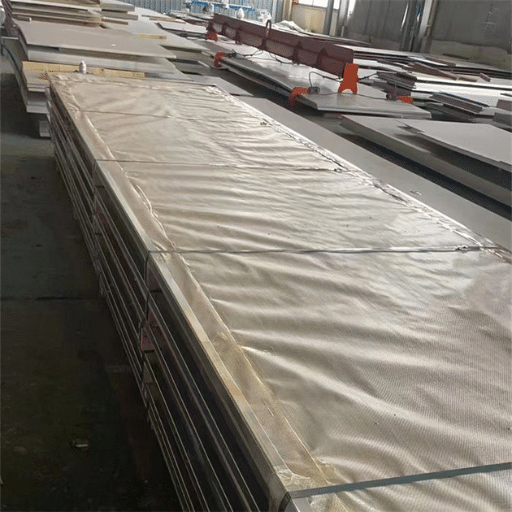
The comparison most procurement directors actually need is not “titanium vs stainless steel” in the abstract. It is Ti-6Al-4V vs 316L. Here is the direct comparison.
| Property | Ti-6Al-4V (Grade 5) | 316L Stainless Steel |
|---|---|---|
| Density | 4.51 g/cm³ | 7.99 g/cm³ |
| Tensile Strength | ~950 MPa | ~485 MPa |
| Yield Strength | ~880 MPa | ~170 MPa |
| Elastic Modulus | ~116 GPa | ~193 GPa |
| Thermal Expansion | 8.6 × 10⁻⁶/°C | 16.0 × 10⁻⁶/°C |
| Hardness (Rockwell C) | ~36 | ~25 (annealed) |
| Seawater Corrosion | Virtually immune | Susceptible to pitting/SCC |
| Typical Cost Tier | Premium (5–10×) | Standard |
| Primary Standards | ASTM B348, AMS 4928 | ASTM A240, ASTM A276 |
When to specify Ti-6Al-4V: Aerospace structures, high-performance medical implants, critical marine components, weight-critical assemblies, and any application where corrosion immunity and low density justify the material premium.
When to specify 316L: General chemical processing, food and pharmaceutical equipment, architectural applications, non-critical marine hardware, and any project where budget constraints outweigh performance requirements.
How to Verify Material Quality and Certification
Receiving the wrong grade of material is not a hypothetical risk. Uncertified or mislabeled alloys enter supply chains regularly, and the consequences range from fabrication rejects to catastrophic in-service failures.
ASTM and ISO Standards to Demand
For titanium, verify conformance to the relevant ASTM or aerospace standard:
- ASTM B348: Bars and billets for general engineering
- ASTM F136: Ti-6Al-4V ELI for surgical implants
- AMS 4928: Aerospace-grade Ti-6Al-4V
- ASTM F67: Unalloyed titanium for surgical implants
For stainless steel, the relevant ASTM standards include:
- ASTM A240: Plate, sheet, and strip for pressure vessels
- ASTM A276: Bars and shapes
- ASTM A312: Seamless and welded pipe
- ASTM F138: Stainless steel for surgical implants
Spectral Analysis and Mill Certification
Alloy-critical material requirements need to have Mill Test Reports (MTRs), which must accompany every material batch. The document delivers certification for heat number and chemical composition, mechanical test results, and standards compliance.
The independent spectral analysis function serves as an extra verification method for highly important applications. The delivered material matches the certified composition when optical emission spectrometry (OES) and X-ray fluorescence (XRF) testing show material results within defined limits.
Supplier Qualification Red Flags
- Vague grade descriptions: Terms like “aircraft grade,” “medical grade,” or “surgical steel” without specific ASTM, AMS, or ISO callouts
- Missing or inconsistent MTRs: Inability to provide heat-number traceable documentation
- Unwillingness to provide independent test reports: Reputable suppliers welcome third-party verification
- Pricing that seems too good: Certified high-performance alloys have floor prices; significant deviations suggest substitution or counterfeiting
Request a quote for certified Ti-6Al-4V or 316L with full traceability documentation.
Frequently Asked Questions
Is titanium stronger than stainless steel?
The tensile strength of Ti-6Al-4V reaches approximately 950 MPa, which exceeds the tensile strength of annealed 316L, which measures 485 MPa. The absolute strength of precipitation-hardened stainless steel (17-4 PH H900) exceeds 1,300 MPa, which makes it stronger than titanium. The specific strength of titanium shows its superiority because its weight-to-strength ratio doubles that of 316L due to titanium being 44% less dense.
Is titanium more expensive than stainless steel?
Yes. The price of Ti-6Al-4V is 5–10 times the price of 316L per kilogram. The total cost of ownership shows titanium as the more economical choice in aerospace applications which require fuel efficiency and marine operations which need maintenance-free performance and medical usage that depends on implant durability.
Can titanium and stainless steel be used together?
The materials cannot have direct contact with electrolytes, which include seawater. The stainless component will experience faster galvanic corrosion because titanium possesses higher nobility than stainless steel. The construction of mixed assemblies requires dielectric isolation through the use of gaskets and coatings along with cathodic protection design.
Which material functions better as a medical implant than titanium?
Titanium (ASTM F136) serves as the standard for permanent implants, which include hip replacements, dental implants, and spinal hardware, because it provides better biocompatibility and osseointegration and it contains no nickel. The use of 316LVM stainless steel as temporary fixation hardware, which undergoes removal after use shows both cost-effectiveness and suitability for its purpose.
What makes titanium the preferred metal choice for aerospace engineers?
The specific strength of titanium enables aircraft structures to support the same weight as steel while weighing only half of steel’s weight. Engineers who design aircraft need to minimize every kilogram of weight because it will lead to reduced fuel use and higher cargo capacity. Engine compressor sections and landing gear components depend on titanium because of its ability to withstand fatigue and its resistance to corrosion.
Can 17-4 PH stainless steel function as a substitute for titanium?
The answer to this question is yes because particular situations require titanium replacement. 17-4 PH H900 reaches higher tensile strength than Ti-6Al-4V while costing around half the material expense. The material demonstrates its best performance in applications that require maximum strength without needing weight reduction for design purposes—this applies to high-strength fasteners, valve stems, and specific structural brackets.
Conclusion
The comparison between titanium and stainless steel does not lead to an absolute victory for either material. The process requires precise identification of material properties, which must match specific project requirements.
Titanium earns its premium where specific strength, corrosion immunity, or biocompatibility are non-negotiable. Aerospace structures, permanent medical implants, and critical subsea equipment are clear titanium applications. Stainless steel serves as the practical standard material for general structural work in projects that need to handle moderate corrosion conditions while keeping costs low because its higher stiffness and wider availability from suppliers provide greater cost benefits.
Engineers and procurement directors who choose materials effectively need different tools than standard comparison tables. The team requires exact grade specifications, while they need certified compliance with ASTM and AMS standards and spectral analysis for composition testing and lifecycle cost modeling, which goes beyond purchase cost assessment.
If your project requires certified Ti-6Al-4V, 316L, or any other high-performance alloy, our metallurgical team is available to review your specifications, verify material certifications, and deliver fully traceable material with ISO 9001 quality assurance. Contact an expert or request a quote today.